What is the difference between Automatic Functions vs AI Systems in Cars?
TL;DR:
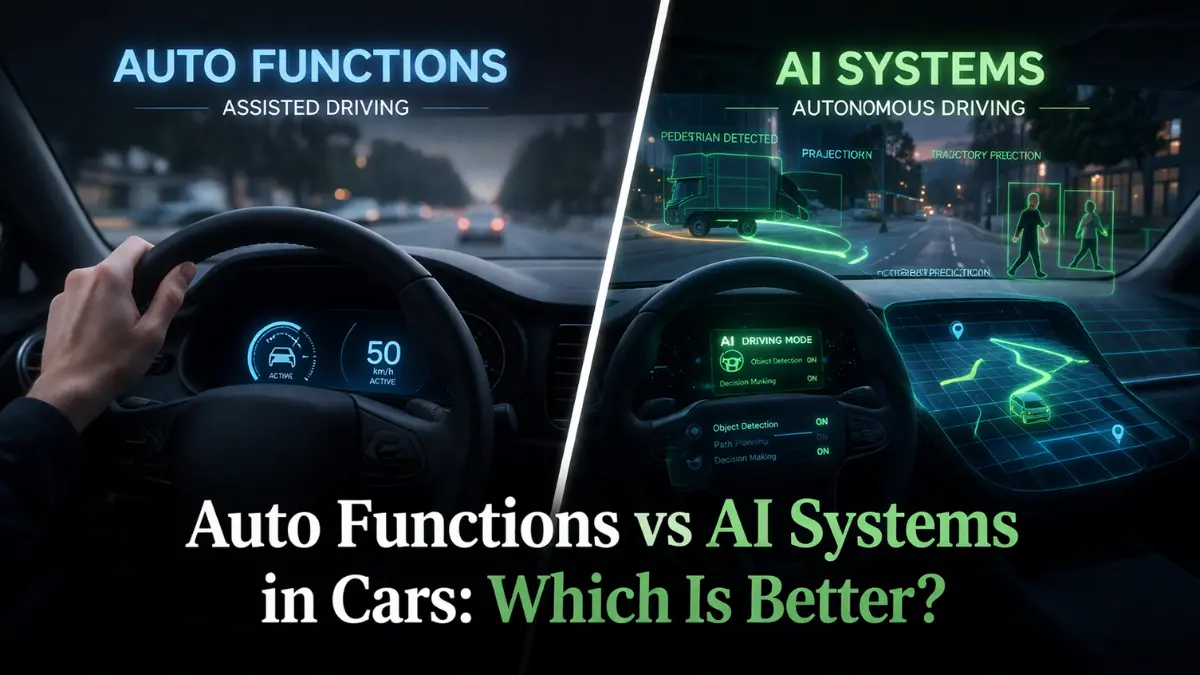
Automatic functions follow fixed rules; they react to triggers and do the same thing every time. AI systems learn, adapt, and predict; they understand context and get smarter with each mile. Real-world data shows AI-powered AEB cuts rear-end crashes by nearly 52%, and NHTSA expects mandatory AI safety features to save 360+ lives per year by 2029. AI costs more upfront, but predictive maintenance alone can slash ownership costs by up to 25%. The real winner? Cars that use both together, letting automation handle the simple, consistent tasks while AI takes on the complex, high-stakes decisions. That hybrid approach is already in your next car. The question is just how much of it you’re ready to use.
- What’s the Difference Between Automatic Functions and AI Systems in Cars?
- How Do Automatic Car Features Actually Work?
- How Are AI Systems in Cars Different From Basic Automation?
- How Do the Two Systems Compare Head-to-Head?
- Are AI Systems in Cars Actually Safer Than Traditional Automation?
- What Does This Mean for the Evolution of Your Daily Commute?
- Is the Cost of AI Features in Cars Worth It?
- What Happens When You Keep Both in the Same Car?
- Frequently Asked Questions
- Conclusion: So, Which One Really Wins?
What’s the Difference Between Automatic Functions and AI Systems in Cars?
Most people use “automatic” and “AI” interchangeably when talking about car features. That’s a mistake.
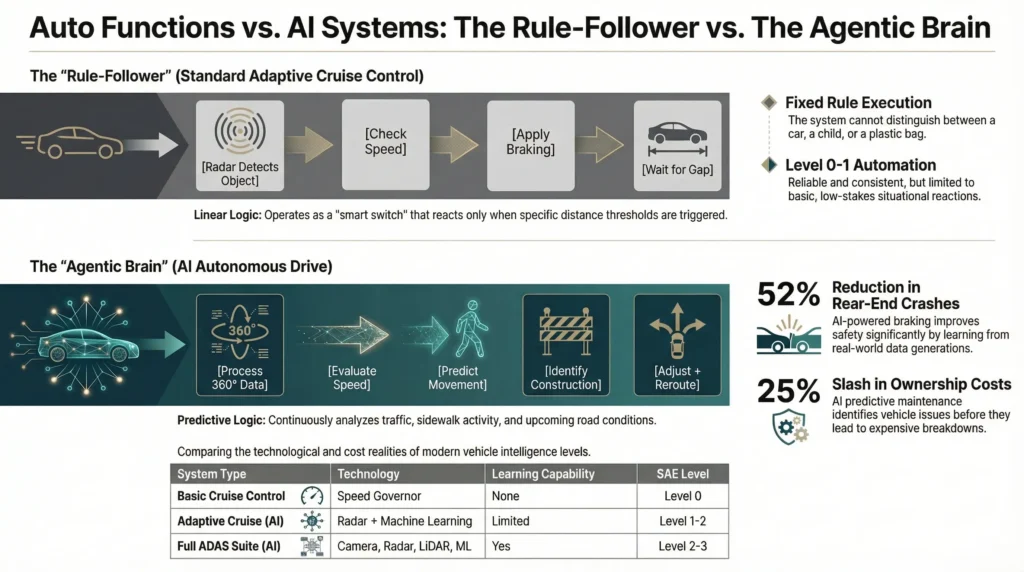
Automatic functions follow fixed rules. They do the same thing every time, in the same situation. Traditional cruise control is a perfect example. You set a speed, the car holds it. That’s it. No learning, no adapting, no thinking. The system reacts to your input and nothing else.
AI systems, on the other hand, learn from data. They analyze what’s around them, predict what might happen next, and make decisions on the fly. A basic automatic system asks: “What did the driver tell me to do?” An AI system asks: “What’s the smartest thing to do right now, given everything I can see and know?”
That’s the core distinction, and it’s a big one.
How Do Automatic Car Features Actually Work?
Think of automatic features as very smart switches. They turn on when a condition is met and turn off when it isn’t.
Standard automatic emergency braking (AEB), for example, uses sensors to detect an object in front of the vehicle. If the distance drops below a threshold and the driver hasn’t braked, the system applies the brakes. It doesn’t consider whether the object is a stopped car, a plastic bag, or a child crossing the road. It just responds to the trigger.
Other examples of classic automatic functions include:
- Traditional cruise control: Holds a fixed speed. No reaction to traffic.
- Automatic headlights: Turns lights on when it gets dark.
- Rain-sensing wipers: Activate when moisture hits the windshield sensor.
- Park distance control: Beeps louder as you get closer to an obstacle.
These features are reliable and consistent. They do exactly what they’re designed to do, no more, and no less. That predictability is both their strength and their limitation.
How Are AI Systems in Cars Different From Basic Automation?
AI systems don’t just react. They understand.
Take adaptive cruise control (ACC) as a bridge example. Early ACC systems were mostly automatic: detect a car ahead, slow down. Modern AI-powered ACC, like what you find in Tesla’s Autopilot or GM’s Super Cruise, does something far more sophisticated. It predicts what the car ahead might do. It watches for vehicles about to merge. It adjusts speed based on road curves, traffic patterns, and even your driving style over time.
According to Kelley Blue Book, AI is what makes Level 3 autonomous driving possible at all. As of early 2025, Mercedes-Benz is the only automaker selling Level 3-capable vehicles in the US, through its Drive Pilot system, available on limited roads in California and Nevada. At Level 3, the car doesn’t just assist you. It takes over, while you remain ready to step back in.
The key capabilities that separate AI from automation include:
- Machine learning: The system improves through exposure to real-world data.
- Computer vision: It identifies objects, pedestrians, lane markings, and road signs visually.
- Sensor fusion: It combines data from cameras, radar, LiDAR, and ultrasonic sensors into a single, unified picture of the world.
- Predictive reasoning: It anticipates what might happen next, not just what’s happening now.
AI systems in cars are not static. McKinsey’s 2025 edge AI report highlights how the most advanced in-vehicle AI can now handle end-to-end driving decisions using a single deep-learning model, processing everything from perception to steering control in real time. That’s a world away from a sensor-triggered brake.
How Do the Two Systems Compare Head-to-Head?
Here’s a clear breakdown so you can see exactly where each technology stands:
| System Type | Technology Used | Approx. Cost Add-On | Learning Capability | SAE Level |
|---|---|---|---|---|
| Basic Cruise Control | Speed governor | $200-$500 | None | Level 0 |
| Parking Sensors | Ultrasonic sensors | $300-$800 | None | Level 0 |
| Lane Departure Warning | Camera + alert | $500-$1,000 | None | Level 1 |
| Adaptive Cruise Control (AI) | Radar + ML | $1,000-$3,000 | Limited | Level 1-2 |
| Full ADAS Suite (AI) | Camera, radar, LiDAR, ML | $3,000-$10,000 | Yes | Level 2 |
| Level 3 System (Mercedes Drive Pilot) | Full sensor fusion + AI | $10,000+ | Yes | Level 3 |
| Level 4-5 Full Autonomy | AI compute + LiDAR + HD maps | $100,000+ | Yes, continuous | Level 4-5 |
The table makes it clear: AI systems do more, cost more, and carry higher stakes. But the safety numbers make a compelling case.
Are AI Systems in Cars Actually Safer Than Traditional Automation?
This is where the data gets compelling.
The largest NHTSA-automaker safety study to date, published in January 2025 and covering 98 million vehicles and 21.2 million crashes, found that AEB systems cut rear-end crashes by 49% overall. Newer vehicles built between 2021 and 2023 showed a 52% reduction, up from 46% in 2015-2017 models. That improvement is AI doing its job: getting smarter with every generation.
NHTSA also projects that when AEB becomes mandatory on all new US vehicles by 2029, the standard will save at least 360 lives per year and prevent over 24,000 injuries annually.
Human error causes approximately 94% of all traffic accidents, according to NHTSA data. AI systems don’t get tired. They don’t get distracted. They don’t check their phone. That’s the core safety argument, and it’s a hard one to argue with.
But here’s the honest caveat: AI systems are not flawless. A 2024 peer-reviewed study in the World Electric Vehicle Journal found that many theoretically sound AI-driven ADAS solutions showed “serious safety flaws in practice.” Deep neural networks can misclassify objects, struggle in bad weather, and behave unpredictably in edge-case scenarios no training data ever covered.
So yes, AI systems are generally safer. But they’re not perfect, and that matters. To understand how these safety features are fundamentally reshaping the automotive landscape, our detailed breakdown of how AI in automotive is transforming car design and safety standards covers the full picture.
What Does This Mean for the Evolution of Your Daily Commute?
Not long ago, a “smart car” meant power windows and a built-in GPS. Today, it means a machine that watches the road, monitors your alertness, predicts traffic patterns, and adjusts itself to your driving habits without being asked.
AutoTech Breakthrough’s 2025 industry report notes that virtually all new vehicles sold in the US now come with some form of AI. And a Ciklum 2025 forecast estimates that by the end of 2025, close to 60% of cars sold globally will carry Level 2 autonomy features, including AI-powered adaptive cruise control, lane-keeping assistance, and collision avoidance systems.
That’s not a futuristic scenario. That’s your next car purchase.
The commute itself is shifting too. AI navigation systems don’t just find the fastest route. They factor in your energy consumption, preferred stops, and even predict how traffic will change in the next 20 minutes. For EV drivers especially, this is transformative. AI-powered route planning now integrates charging station availability and real-time battery health to give you an accurate picture of exactly how far you can go. For more on where this is all heading, our piece on automotive artificial intelligence and the future of smart vehicles explores the road ahead in detail.
Is the Cost of AI Features in Cars Worth It?
This is the question car buyers actually care about.
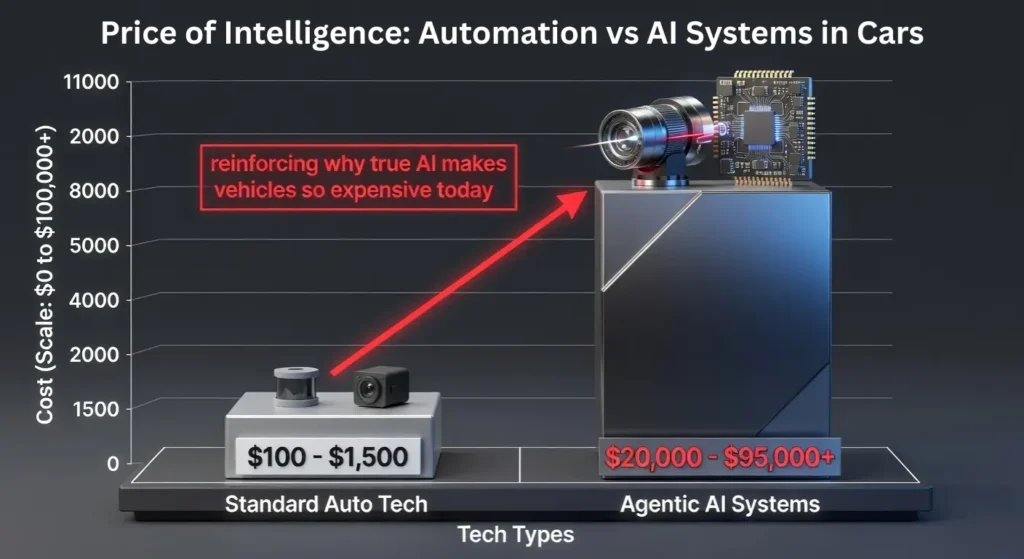
According to PatentPC’s AV cost breakdown, a basic Level 2 system adds roughly $1,000 to $5,000 to a vehicle’s price. A fully autonomous Level 4 or 5 setup costs over $100,000 in added components alone. That’s a wide spectrum.
On the other side of that equation: AI-powered predictive maintenance alone can reduce maintenance costs by up to 25%, according to data cited by Deloitte. Fewer emergency repairs. Fewer breakdowns. Longer vehicle life. Over the full ownership period, that’s meaningful money back in your pocket.
Then there’s the insurance angle. Vehicles equipped with proven ADAS features often qualify for lower premiums. When AEB systems cut crashes nearly in half, insurers notice.
The real cost question isn’t “is AI expensive?” It’s “what does it cost you when your car can’t see what’s coming?”
What Happens When You Keep Both in the Same Car?
Here’s what most people miss: automatic functions and AI systems aren’t competing. In the best cars on the road today, they work together.
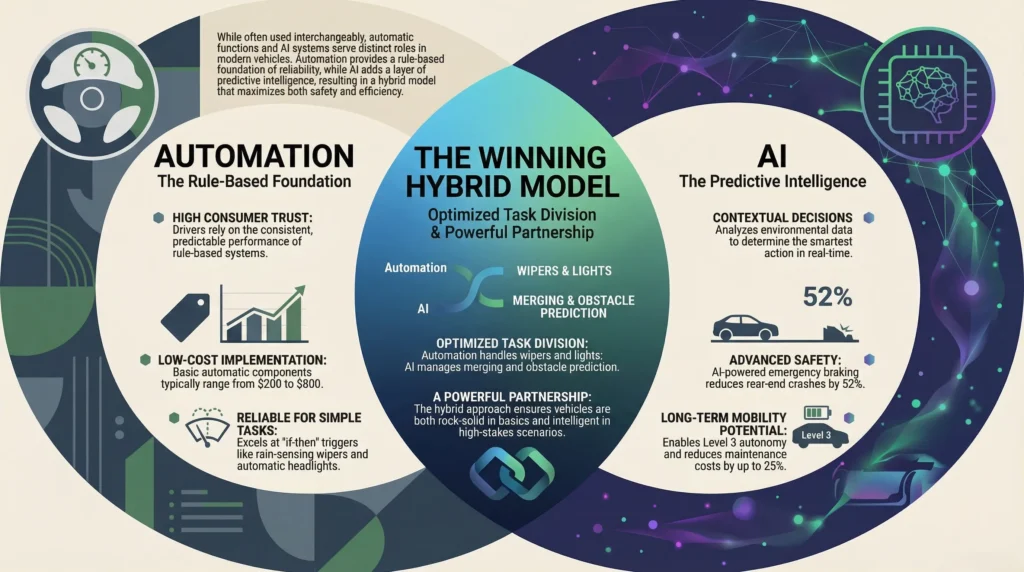
Traditional automatic features handle the simple, reliable, low-stakes tasks. Your automatic headlights still come on at dusk. Your rain sensors still run the wipers. Those systems don’t need AI. They just need to work consistently.
AI handles the complex, high-stakes, dynamic decisions. When a pedestrian steps off a curb at night, or a truck cuts across three lanes at highway speed, you want a system that thinks, not one that just triggers.
McKinsey’s hybrid AI framework describes this coexistence clearly: simpler vehicle functions are processed locally and instantly, while more complex AI reasoning draws on cloud-based models and large-scale data. The result is a car that’s both rock-solid reliable in the basics and genuinely intelligent when it counts.
This is the real answer to “who comes out on top?” Neither one wins alone. The future of driving belongs to cars smart enough to know when to be automatic and when to think.
Frequently Asked Questions
What is the difference between automatic functions and AI systems in cars?
Automatic functions follow fixed, pre-programmed rules and react to specific triggers the same way every time. AI systems use machine learning to learn from data, adapt to new situations, and make predictive decisions in real time. Automatic features include things like traditional cruise control and auto headlights. AI systems include adaptive cruise control, lane-keeping assist powered by computer vision, and predictive emergency braking.
Are AI systems in cars safer than traditional automatic features?
Yes, AI-powered systems demonstrate significantly better safety outcomes. A January 2025 NHTSA-MITRE study covering 98 million vehicles found that AI-enhanced AEB systems reduced rear-end crashes by 52% in newer vehicles. NHTSA also projects that mandatory AEB will save at least 360 lives and prevent 24,000 injuries per year by 2029.
How much do AI car features cost compared to automatic features?
Basic automatic features like parking sensors or rain-sensing wipers typically add $500 to $2,000 to a vehicle’s price. A Level 2 AI system, including adaptive cruise control and lane-keeping assist, adds roughly $1,000 to $5,000. Fully autonomous Level 4 or Level 5 technology adds over $100,000 in components. However, AI predictive maintenance can reduce total ownership costs by up to 25%.
What is the difference between Level 1 and Level 2 car automation?
Level 1 automation handles one task at a time, such as adaptive cruise control controlling speed, but the driver manages everything else. Level 2 automation combines two or more systems working simultaneously, such as adaptive cruise control plus lane centering, allowing the car to steer, accelerate, and brake on its own under certain conditions. The driver must still remain attentive and keep their eyes on the road.
Can a car have both automatic functions and AI systems?
Yes, and most modern vehicles do. Automatic functions handle simple, reliable, low-stakes tasks like turning on headlights or running windshield wipers. AI systems handle complex, dynamic decisions like predicting a pedestrian’s movement or adjusting speed in heavy traffic. The two technologies work side by side, with AI increasingly making traditional automatic features smarter over time.
What is sensor fusion in AI cars?
Sensor fusion is the process by which an AI system combines data from multiple sensors simultaneously, including cameras, radar, LiDAR, and ultrasonic sensors, to build a complete, real-time picture of the vehicle’s surroundings. Unlike basic automatic systems that rely on a single sensor for a single task, sensor fusion allows AI to identify objects, predict behavior, and make more accurate safety decisions.
Conclusion: So, Which One Really Wins?
Automatic functions built the foundation. They gave us safer, more consistent vehicles without demanding anything from the driver. They deserve full credit for that.
But AI systems are taking us somewhere else entirely. They learn. They predict. They improve. They’re already cutting crash rates in half and redefining what “safety” even means behind the wheel.
The verdict isn’t that one replaces the other. It’s that AI is rapidly absorbing automation into itself, making every automatic function smarter than it was before. Your next car won’t just react to the road. It’ll understand it.
The question isn’t whether AI belongs in your car. It already is. The question is how much of it you’re ready for.

Tarang bridges the critical gap between machine learning capabilities and actual consumer action. With deep roots in performance marketing and campaign optimization, he analyzes how AI is actively disrupting ad-tech, personalization, and customer acquisition, ensuring our readers understand the true ROI of AI tools.