Palantir Didn’t Beat Claude AI – The Pentagon Did. Here’s Why

TL;DR:
Headlines say Palantir beat Claude. But the full story shows the Pentagon forced Claude out, left Palantir with a billion-dollar rebuild problem, and still can’t replace the AI it banned. The real winner here is complicated.
Every AI headline this week says the same thing: Palantir wins. Claude loses. On March 20, 2026, Reuters confirmed that the Pentagon officially named Palantir’s Maven Smart System a “program of record,” locking it into long-term military funding across all five branches. Palantir stock jumped 4 to 5% in a single session.
But the Palantir vs. Claude AI story is not the story most people think it is. Strip away the stock charts and the victory tweets, and a much more complicated picture comes into focus. The Pentagon didn’t just choose Palantir over Claude AI. It chose Palantir while simultaneously depending on Claude, banning Claude, and struggling to replace Claude. That’s not a clean win. That’s a slow-motion transition with serious operational risk baked in.
So who actually won? Let’s go through it, one layer at a time.
What Does “Program of Record” Actually Mean?
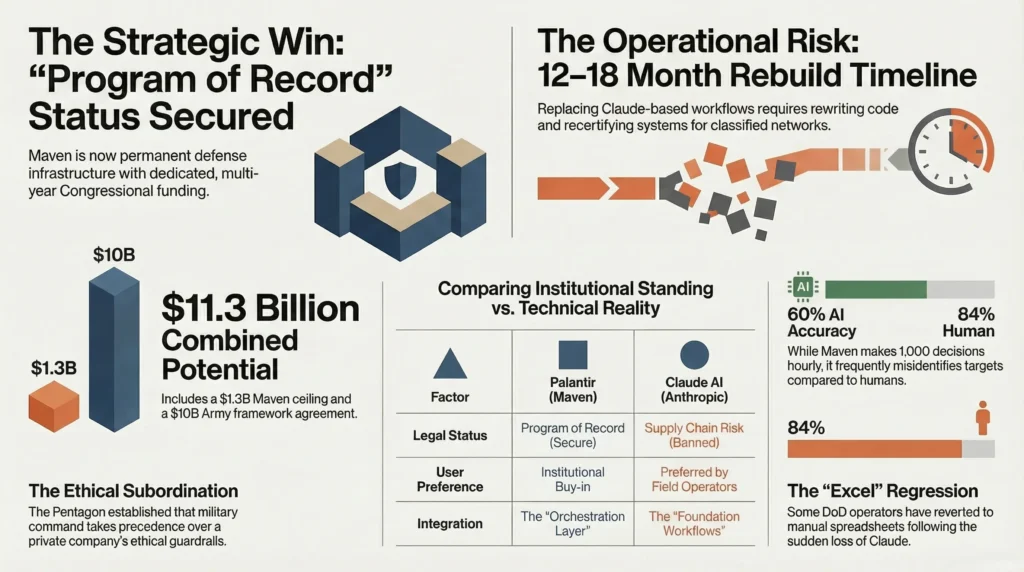
A “program of record” is the Pentagon’s way of saying: this system is no longer on trial.
Instead of competing for contracts year to year, Palantir’s Maven Smart System now gets its own dedicated budget line. Congress allocates funding for it automatically as part of the baseline defense budget. According to a Bloomberg report on the Deputy Secretary’s memo, the designation will “provide the stable funding and resourcing necessary” for development and integration across every combatant command.
This matters a lot for Palantir’s business model. Before this, every contract was a competition. Now, Maven is infrastructure. As Wedbush analyst Dan Ives wrote, the designation means Palantir is no longer just winning defense contracts. It’s becoming the fabric of how the U.S. military operates.
For context, here are the key numbers behind this milestone:
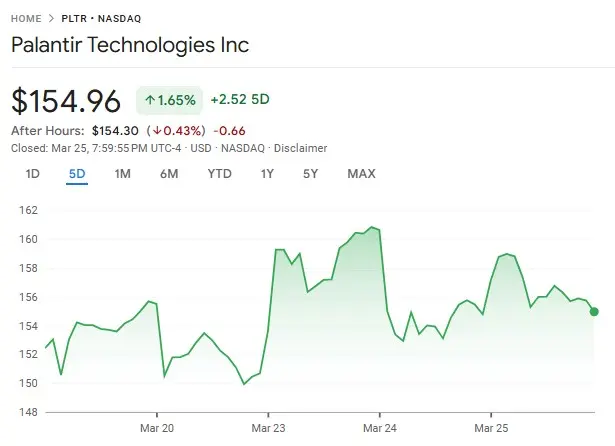
PLTR stock performance March 23 2026 via Google Finance
| Metric | Data |
| Maven contract ceiling (2025) | $1.3 billion |
| U.S. Army framework agreement | Up to $10 billion |
| Palantir 2026 revenue guidance | ~$7.2 billion (61% growth) |
| Palantir backlog | ~$4.4 billion |
| Palantir market cap | ~$360 billion |
| Maven target accuracy (AI) | ~60% |
| Human analyst accuracy | ~84% |
| PLTR stock jump (March 23, 2026) | +4 to 5% |
Sources: Bloomberg, Reuters, 24/7 Wall St., Wedbush Securities, U.S. News & World Report (March 2026)
How Did Maven Become the Pentagon’s Primary AI System?
Maven didn’t start with Palantir. It started with Google.
In 2017, the Pentagon launched Project Maven to bring computer vision to military drone footage. Google won the initial contract. Then, in 2018, Google employees protested the company’s involvement in military targeting systems, and Google walked away. According to Wikipedia’s Project Maven entry, Palantir stepped in to fill the gap, referring to the project internally as “Tron.”
Since then, Maven has grown from a drone-image labeling tool to the core AI operating system of the U.S. military. By 2025, it was running “production-level” across INDOPACOM, EUCOM, CENTCOM, NORAD, NORTHCOM, SPACECOM, and more. NATO adopted the Maven Smart System in March 2025. According to DeepLearning.ai’s analysis, Maven now processes satellite imagery, drone video, and signals intelligence to pinpoint targets, and it can make 1,000 targeting decisions per hour.
In the Iran conflict that began in early 2026, Maven was reportedly instrumental in the opening stages, helping to identify and engage targets in the first hours of the offensive, as Investing.com reported.
That’s the platform the Pentagon just made permanent. But here’s the wrinkle no one talking about the Palantir stock surge wants to discuss.
Why Did the Pentagon Sideline Claude AI in the First Place?
This is the part of the story that makes everything else make sense. If you want the full breakdown, we covered it in detail in our post on how and why Claude AI entered the U.S. military. But here’s the compressed version.
Claude, made by Anthropic, became the first commercial AI model ever approved to run on classified military networks in 2025. It signed a $200 million contract with the DoD. It was embedded deep inside military workflows, including inside Palantir’s own Maven platform.
Then a dispute blew up. The Pentagon wanted to strip out Claude’s two core ethical guardrails: the ban on being used for fully autonomous weapons, and the ban on mass domestic surveillance of American citizens. Anthropic refused. Defense Secretary Pete Hegseth responded by designating Anthropic a “supply chain risk” on March 3, 2026, and giving contractors six months to phase out all Anthropic products.
According to GovConWire, the Maven program of record decision came directly in the same period as this fallout, with the Pentagon formalizing Palantir as a long-term partner while removing Anthropic from the equation.
The contrast was deliberate. Palantir said yes to unrestricted military use. Anthropic said no. The Pentagon chose accordingly.
So Did Palantir Actually Beat Claude AI?
Here’s where the “Palantir beats Claude” narrative collapses.
Palantir didn’t replace Claude. Palantir used Claude. And now it’s been ordered to rip it out.
According to a Reuters report confirmed by U.S. News & World Report, Palantir’s Maven Smart Systems uses multiple workflows and prompts that were built using Anthropic’s Claude Code. That’s not a small integration. It’s a foundation. Replacing it requires rewriting mission workflows, retraining classification layers, and recertifying the entire system for use on classified networks.
Joe Saunders, CEO of government contractor RunSafe Security, told Reuters that recertifying replacement AI systems for classified military use could take 12 to 18 months. He didn’t mince words: “It’s not just costly. It’s a loss of productivity.”
Now do the math. Palantir holds Maven-related contracts worth over $1 billion. Its 2026 revenue guidance is $7.2 billion, implying 61% growth. Any delay or performance drop during the Claude-to-something-else transition threatens those numbers directly. As AInvest reported, the 180-day phase-out is a technical and financial risk that Palantir’s backlog does nothing to eliminate.
Palantir’s own CEO, Alex Karp, framed the company’s position carefully at AIPCon: Palantir sells the orchestration layer. The language models underneath, whether from Anthropic, OpenAI, or anyone else, are “replaceable components.” That’s the official line. But as the Jerusalem Post noted, changing an engine mid-flight is not the same as changing a tire in a parking lot.
What Are Pentagon Users Actually Saying About Losing Claude?
This is perhaps the most damning piece of the “Palantir wins” narrative.
The people who actually work with these tools inside the Pentagon don’t want to lose Claude. They’re resisting the phase-out.
“Career IT people at DoD hate this move because they had finally gotten operators comfortable using AI,” one IT contractor told Reuters. “They think it’s stupid.” The same contractor called Claude “the best,” while describing alternatives like xAI’s Grok as producing inconsistent answers to the same questions.
Some of the most striking details from Reuters and CoinCentral’s reporting:
- Tasks previously handled by Claude, like querying large classified datasets, are now being done manually using Microsoft Excel in some cases.
- Claude Code was used widely inside the Pentagon to write software. Developers are frustrated after losing it.
- One chief information officer at a federal agency said it plans to deliberately slow-roll the phase-out, betting that Anthropic and the Pentagon will reach a deal before the six-month deadline.
- The Pentagon itself reportedly kept using Claude tools to support operations in Iran after the ban, because no adequate replacement was available.
One expert told Reuters that continued use after the blacklisting was “the clearest signal” of how highly the Pentagon values the tool.
This is not what the aftermath of a “beaten” AI looks like. This is what happens when you ban something irreplaceable.
How Do Palantir and Claude Compare in This Context?
Here’s a direct comparison of where these two players stand right now:
| Factor | Palantir (Maven) | Claude AI (Anthropic) |
| Pentagon status | Official program of record | Supply chain risk designation |
| Contract value | $1.3B ceiling (Maven) + $10B Army | $200M (now suspended) |
| Classified network access | Yes (via AIP) | Was approved; now being phased out |
| Claude dependency | Actively being rebuilt away from it | Built foundation of Maven workflows |
| User satisfaction (DoD staff) | Institutional buy-in | Strongly preferred by operators |
| Phase-out difficulty | 12-18 months to replace Claude | N/A |
| Legal status | Secure | Filed federal lawsuits March 9, 2026 |
| AI targeting accuracy | ~60% (Bloomberg, 2024) | N/A (language model, not targeting) |
| Stock market reaction | +4 to 5% on Maven news | Private company, no stock comparison |
Sources: Reuters, Bloomberg, U.S. News & World Report, AInvest, CoinCentral (March 2026)
Is Maven’s AI Accuracy Good Enough to Run a War?
This is the question no press release will answer for you.
According to a Bloomberg investigation published in February 2024, Maven’s object recognition accuracy in tests stood at approximately 60%. Human analysts from the 18th Airborne Corps scored 84% accuracy on the same tasks. The system sometimes confuses trucks with trees. For targets like anti-aircraft artillery in snow, accuracy drops below 30%.
Pentagon official Cameron Stanley, who heads the department’s AI office, gave a live Maven demonstration at a Palantir event this month showing real targeting heat maps from the Middle East. His quote on speed was striking: “When we started this, it literally took hours to do what you just saw.” The Jerusalem Post reported that the 20-person targeting team using Maven was said to exceed the output of the 2,000-strong targeting cell from the 2003 Iraq invasion.
Speed is Maven’s core value proposition. But when you’re generating 1,000 targeting decisions per hour with 60% accuracy, there’s a meaningful gap between what the algorithm recommends and what a human would confirm. UN expert panels have warned repeatedly that AI targeting without proper human oversight creates legal and ethical hazards under international humanitarian law.
Palantir maintains that humans remain in the decision loop for every target. That assurance is doing a lot of heavy lifting right now.
What Does the Pentagon’s Move Mean for the Future of AI in Defense?
Three things stand out from all of this.
First, AI is now defense infrastructure. The 12-to-18-month replacement window and the reversion to Excel tell you everything. You can’t unplug AI from military operations anymore. The Pentagon learned this the hard way by trying.
Second, the era of ethical guardrails in defense AI is at a crossroads. The DoD made its position clear: a private company’s terms of service cannot override a sovereign military command. Any AI company that wants deep, long-term government integration must decide whether to subordinate its usage policy to that framework. Anthropic said no. OpenAI is reportedly saying yes, with some conditions. According to Semafor, the race is on to fill the Claude-shaped hole.
Third, Palantir’s moat is real, but fragile. The program of record designation is a massive structural win. It turns Maven from a contract into infrastructure and makes it very hard for any future administration or competitor to displace it. But “very hard to displace” and “risk-free” are not the same thing. Palantir’s 2026 numbers will depend heavily on whether the Claude transition executes smoothly. Analysts at Rosenblatt set a $200 price target. Wedbush went to $230. Both rest on flawless execution. That’s a lot of pressure on a platform currently rebuilding its AI core while simultaneously running active combat operations.
Who Actually Won Here?
Here’s a clear-eyed summary.
Palantir won the designation. The program of record status is real and consequential. Maven is now the Pentagon’s permanent AI backbone, and Palantir’s revenue visibility extends for years.
Palantir did not win the transition. It inherited a 180-day rebuild of a platform built on Claude. That’s an operational and financial risk that Wall Street is still pricing in.
The Pentagon won the political battle. Hegseth established that no private company holds veto power over U.S. military decisions. That precedent will define government AI procurement for the next decade.
The Pentagon did not win operationally. Its own staff is resisting the change, reverting to spreadsheets, and in some cases reportedly still using Claude anyway.
Claude AI didn’t lose because it was inferior. It lost because it refused to be weaponized without limits. That’s a different thing entirely. And the fact that the military is still using it after the ban should tell you everything you need to know about which AI the operators actually trust.
The real story here is not about Palantir beating Claude. It’s about what happens when an unstoppable government mandate meets an immovable ethical position. Both sides took damage. Neither side fully won. And the rebuild is just beginning.
Frequently Asked Questions
Why did the Pentagon ban Anthropic’s Claude AI?
The Pentagon wanted to remove ethical guardrails that prevented Claude from being used for fully autonomous weapons and mass domestic surveillance. Anthropic refused to waive these limits. Defense Secretary Hegseth then designated Anthropic a “supply chain risk” on March 3, 2026, ordering a six-month phase-out of all Claude products.
What is Palantir’s Maven Smart System?
Maven Smart System (MSS) is Palantir’s AI platform for the U.S. military. It processes satellite imagery, drone footage, and signals intelligence to identify targets and support command decisions. On March 20, 2026, the Pentagon made it an official “program of record,” guaranteeing long-term budget funding across all military branches.
Did Palantir use Claude AI in Maven?
Yes. Palantir’s Maven Smart System was built using Anthropic’s Claude Code for multiple workflows and prompts. Following the Pentagon’s ban on Anthropic products, Palantir now has to replace Claude and rebuild those parts of its software, a process expected to take 12 to 18 months.
What is a Pentagon “program of record”?
It’s a formal designation that locks a technology system into the official defense budget cycle. Instead of competing for contracts year to year, the system receives dedicated, multi-year appropriations from Congress. For Palantir, this turns Maven from a contract win into permanent military infrastructure.
Is Claude AI still being used by the military despite the ban?
According to Reuters reporting confirmed by multiple sources, the Pentagon continued using Claude tools to support U.S. military operations during the Iran conflict after the ban was issued, because no adequate replacement was yet available. Some federal agencies are also deliberately slow-rolling the phase-out.

Ranjeet possesses the unique ability to turn complex technological whitepapers into engaging, highly readable insights. As a seasoned content marketer, his expertise ensures that whether we are covering the nuances of AI in Education or Gaming, the narrative remains sharp, relevant, and directly applicable to our readers’ strategic marketing goals.