TL;DR:
Over 45,000 gaming jobs vanished between 2022 and mid-2025. Everyone blames AI. The data tells a far messier story – one involving a pandemic sugar rush, reckless acquisition sprees, and executives hiding bad decisions behind the word “restructuring.” AI is a factor. But it’s not the main villain. Here’s what the numbers actually say.
Gaming layoffs have become a weekly headline. Studios close. Teams dissolve. Developers post heartbreaking LinkedIn updates. And almost every comment section points the finger at AI.
That explanation is too easy. The real story behind gaming layoffs involves bad timing, bloated headcounts, and leadership decisions made in 2020 that the industry is still paying for today. AI plays a role, but it’s a supporting character, not the lead. Let’s break it down.
Is the pandemic really to blame for gaming layoffs?
To be honest, yes, and the numbers are hard to argue with.
When COVID hit, gaming exploded. People stayed home, bought consoles, and streamed games 24/7. Studios saw revenue surge across the board and assumed the growth would last. So they hired aggressively, spent billions on acquisitions, and built teams for a world that no longer existed once lockdowns ended.
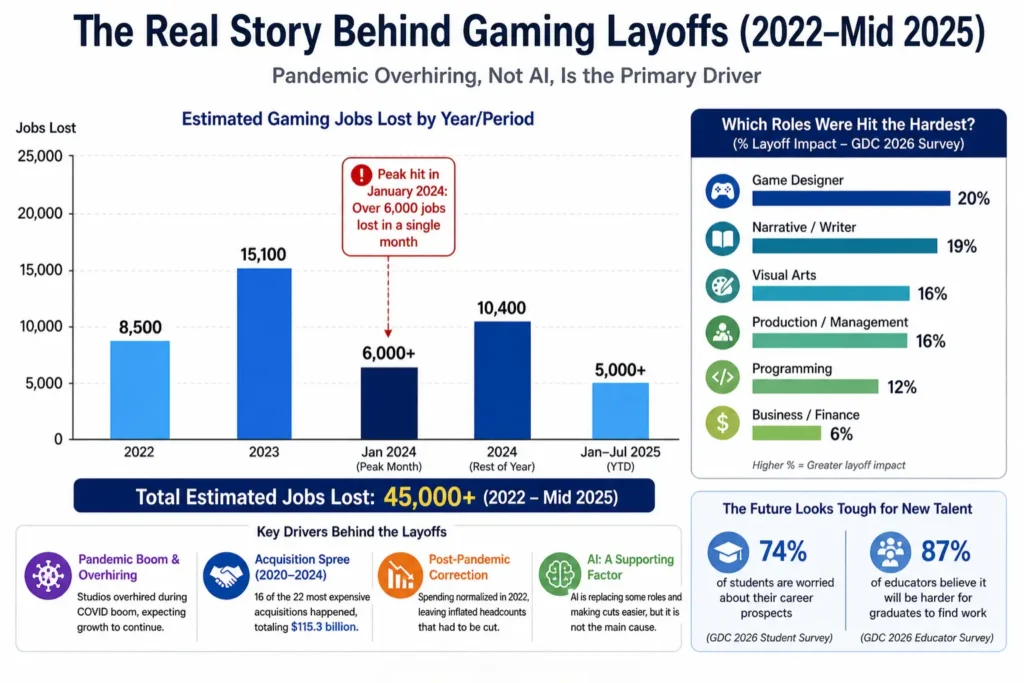
Between 2020 and 2024, 16 of the 22 most expensive video game acquisitions in history took place. Deals totaled $115.3 billion. That’s not AI disruption. That’s greed meeting a one-time opportunity.
When spending normalized in 2022, studios were left holding inflated headcounts they couldn’t justify. The correction was brutal. An estimated 45,000 gaming jobs were lost between 2022 and July 2025. The peak hit in January 2024, when over 6,000 jobs vanished in a single month.
One developer surveyed by GDC put it plainly: their company’s leadership “failed to see that the Covid-era boom was not permanent, and went on an acquisition spree before being acquired. Now money is a lot tighter because the goldfish with the money want returns yesterday so they can funnel it into the current fad (genAI).”
That quote does a lot of heavy lifting.
So is AI Actually Causing Gaming Layoffs?
Only “AI” is not the main reason. But the data doesn’t support the full narrative.
Even Wikipedia’s comprehensive layoff tracker states there is “no indication that layoffs have been driven directly by AI adoption.” The post-pandemic correction carries far more weight as a cause.
That said, AI isn’t innocent. Some companies have explicitly replaced roles with AI tools. Australian blockchain gaming company Immutable axed a third of its staff over nine months and replaced some of those roles with AI. A Wired investigation found that Activision Blizzard was exploring heavy AI use at the same time it cut 1,900 jobs following Microsoft’s acquisition.
AI may also be having a quiet, indirect effect. Roles in concept art, 2D illustration, and basic QA testing, areas where AI tools have improved the most, are becoming easier to justify cutting. So while AI didn’t cause the current wave, it’s making it easier for executives to not replace roles they eliminate.
That’s a meaningful distinction. And it matters for what comes next.
We’ve explored this tension in more depth in our look at when AI will actually replace game developers, and the answer is more nuanced than the headlines suggest.
Who Is Actually in the Crosshairs?
Game Designers, Narrative Writers, and Quality Assurance testers face the highest risk. Highly specialized programmers and art directors remain much safer from automation.
According to the GDC 2026 State of the Game Industry report, which surveyed over 2,300 professionals, game designers absorbed the highest layoff rate at 20%. Narrative and visual arts roles followed closely behind. Business and finance roles saw the least disruption.
Here’s a comparison of which roles faced the most pressure:
| Role | Layoff Impact (GDC Data) | AI Exposure Level |
| Game Designer | 20% | High (procedural/level gen tools) |
| Narrative / Writer | 19% | High (LLM-based dialogue tools) |
| Visual Arts | 16% | High (Midjourney, DALL-E, Meshy) |
| Production / Management | 16% | Medium |
| Programming | 12% | Medium (code generation tools) |
| Business / Finance | 6% | Low |
The pattern here isn’t random. The roles hit hardest are exactly the ones where AI tools have advanced the most. Coincidence is possible. But it’s worth noticing.
The GDC 2025 report also found that artists are the most opposed to generative AI: 64% view it negatively. Designers came in at 63%. These are the same groups losing jobs at the highest rates. That correlation deserves attention.
Why Are Junior Developers Being Squeezed the Hardest?
Because they’re the easiest to cut, and AI is making that easier to justify.
Wikipedia’s layoff data notes that “the layoffs affected junior staff in greater numbers than other skill levels, and in some cases juniors were specifically targeted.” Entry-level roles in art, QA, and basic programming are precisely the areas where AI tools are now handling routine tasks.
The result: studios can operate with fewer junior hires while leaning on AI for early-stage production work. Senior talent retains value because they can direct that AI effectively. Juniors, who once gained experience through those same foundational tasks, are squeezed out before they can build that expertise.
The GDC 2026 student survey makes this painfully clear. Three-quarters (74%) of students studying game development are worried about their career prospects. Educators are even more alarmed: 87% believe it will be harder for graduates to find work. These aren’t just feelings. They reflect a structural change in how studios are hiring.
If you’re curious about what it actually takes to build a game with today’s AI tools, our breakdown of how easy it is to build a game with AI shows exactly why entry barriers are falling, and why that’s a double-edged sword for new developers.
Is “Restructuring” Just a Corporate Smokescreen?
Often, yes. Corporate leaders frequently blame shifting consumer habits for avoiding accountability. They use technology buzzwords to cover up poor management and failed financial bets.
When companies announce layoffs, they almost never say “we made bad decisions.” Instead, they reach for sanitized language. According to the GDC 2026 report, the top reasons cited by companies were restructuring (43%), budget cuts (38%), market conditions (38%), project cancellations (32%), and strategic shifts (31%).
Notice what’s not on that list: “we over-hired during a pandemic boom.”
Microsoft is the clearest example. In July 2025, the company announced over 9,000 layoffs in its gaming division. At the same time, it reported a year of “record performance” in revenue and operating income. Strong earnings. Fewer people. That’s not a company struggling; that’s a company redirecting budget toward AI infrastructure and reducing human overhead.
Ubisoft has run a similar playbook. The company cited “restructuring” in 2023, 2024, and again in early 2026, each time closing studios and cutting teams while framing it as strategic focus. Their share price hit a 14-year low amid the latest announcements.
Game developer Yoko Taro warned about exactly this dynamic years before it became the industry’s dominant narrative. His concern wasn’t just about AI replacing creators; it was about the business logic of human creativity losing out to cheaper, faster alternatives. Our deep dive into why Yoko Taro urges caution with AI in game development explores this argument in full.
Is AI Actually Creating Opportunity for Indie Developers?
Yes. Solo creators and small indie studios use AI tools to dramatically lower development costs. They are competing directly with AAA publishers during this turbulent economic time.
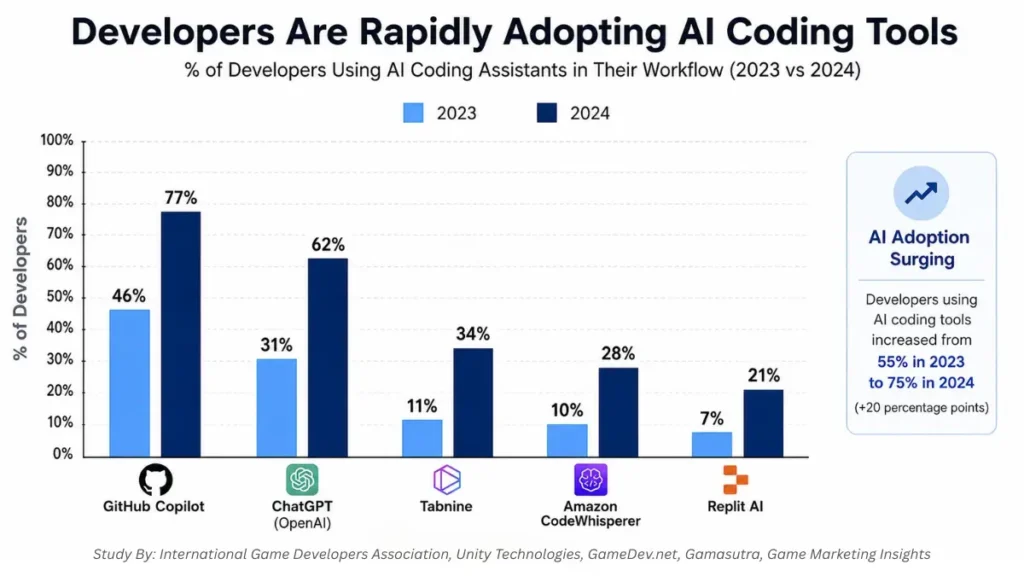
While AAA studios are shrinking, something else is growing. The GDC 2026 report found that 35% of developers now primarily self-fund their projects. More developers are working independently or in small indie teams than at any point in recent memory.
AI is a big reason why that’s viable. Tools like Midjourney, Meshy, and Ludo.ai let solo creators build assets, animate characters, and design environments in a fraction of the time those tasks once required. A 2024 study by the International Game Developers Association found that 35% of indie developers already use procedural generation, with AI playing a major role. The same developers who lose access to AAA jobs are now better equipped than ever to ship games independently.
The success of titles like Black Myth: Wukong, built by a relatively small team, proved that smaller studios can compete at the highest level. AI doesn’t guarantee that outcome. But it removes the most common roadblocks: team size, asset production time, and budget for technical execution.
Medium’s 2025 analysis of indie development put it simply: “2025 is the first year where a single-person studio can ship content pipelines that used to cost AAA budgets.”
For experienced developers pushed out of corporate studios, this isn’t just a silver lining. It’s a viable exit ramp.
What do the Numbers Really Tell Us?
They tell us the gaming industry had a reckoning that was always coming. The pandemic accelerated hiring, investment, and ambition beyond what the market could sustain. The correction was painful. It’s still ongoing.
AI is part of the new landscape, but it didn’t cause the crisis. It’s reshaping how the industry recovers from it. That recovery looks different depending on who you are.
If you’re a junior artist or writer at a AAA studio, the outlook is difficult. Those roles face the most AI exposure and the least institutional protection. If you’re an experienced developer willing to go independent, the tools available today make that path more realistic than it has ever been.
The gaming industry isn’t dying. It’s restructuring, and this time, that word actually means something. The question is who gets to be part of what it becomes.
Frequently Asked Questions
Are gaming layoffs caused by AI?
Not primarily. The main driver is post-pandemic overexpansion. However, AI is making it easier for companies to eliminate creative and junior roles without replacing them, which extends the impact of the correction.
Which game developer roles are most at risk from AI?
According to GDC 2026 data, game designers (20% layoff rate), narrative writers (19%), and visual artists (16%) face the highest exposure. These are the roles where AI tools have advanced the most.
Why are junior developers being targeted in gaming layoffs?
Junior roles in art, QA, and coding are the areas AI handles best. Studios can lean on AI tools for early-stage tasks instead of hiring entry-level staff, squeezing out the traditional pipeline for new talent.
Is indie game development growing despite layoffs?
Yes. Over 35% of developers now primarily self-fund their work, and AI tools are making solo and small-team development more viable than ever. The same technology pressuring AAA jobs is empowering indie creators.
What does “restructuring” mean when studios announce layoffs?
Usually, it means rebalancing priorities to cut labor costs while maintaining or growing AI investment. Microsoft, EA, and Ubisoft all used the term while reporting strong revenue or strategic pivots toward generative AI tools.

With a profound background in digital strategy and market intelligence, Kishan oversees the overarching editorial direction of IndustrifyAI. He specializes in identifying macro-level AI trends from automotive automation to generative tech and translating them into comprehensive, forward-looking industry forecasts that empower business leaders.