
TL;DR:
Gamers say they hate AI. But the data tells a messier story. Gamers are arguably the biggest consumers of AI technology on the planet. They despise AI-generated art and voices. They love AI that boosts their frame rate and builds their game worlds. They just prefer it to be invisible.
This post breaks down exactly where the line is, who’s drawing it, and whether it will even matter five years from now.
Key Takeaways
- 85% of gamers hold a negative view of generative AI in games, according to a December 2025 Quantic Foundry survey of 1,799 players.
- 80% of NVIDIA RTX users actively enable DLSS, an AI-powered upscaling technology, according to NVIDIA’s own January 2025 data.
- The Finals attracted 7.5 million players during its open beta despite a massive backlash over AI voice acting.
- 1 in 5 Steam games released in 2025 used generative AI, up 681% year-on-year, per research by Totally Human Media.
- Gamers are not anti-AI. They’re anti-visible AI. The distinction matters more than most people realize.
Is the Gaming Community’s AI Hate Actually Real?
Yes. And no.
The headlines are not lying. A December 2025 survey by Quantic Foundry, one of the most respected research firms in the gaming space, found that 85% of gamers hold a below-neutral attitude toward generative AI in video games. A staggering 63% selected the most negative response available. For context, that’s worse than how gamers feel about blockchain games, which themselves scored a deeply unpopular 79% negative in a prior survey.
So yes, the hate is real.
But here is the part most coverage conveniently leaves out. Those same gamers are running AI on their machines right now. While they tweet about studios ruining games with AI, their GPUs are using deep learning to generate pixels they never actually rendered. The question worth asking isn’t whether gamers hate AI. It’s which AI they hate, and why.
What AI Do Gamers Actually Love?
They love the AI they can’t see.
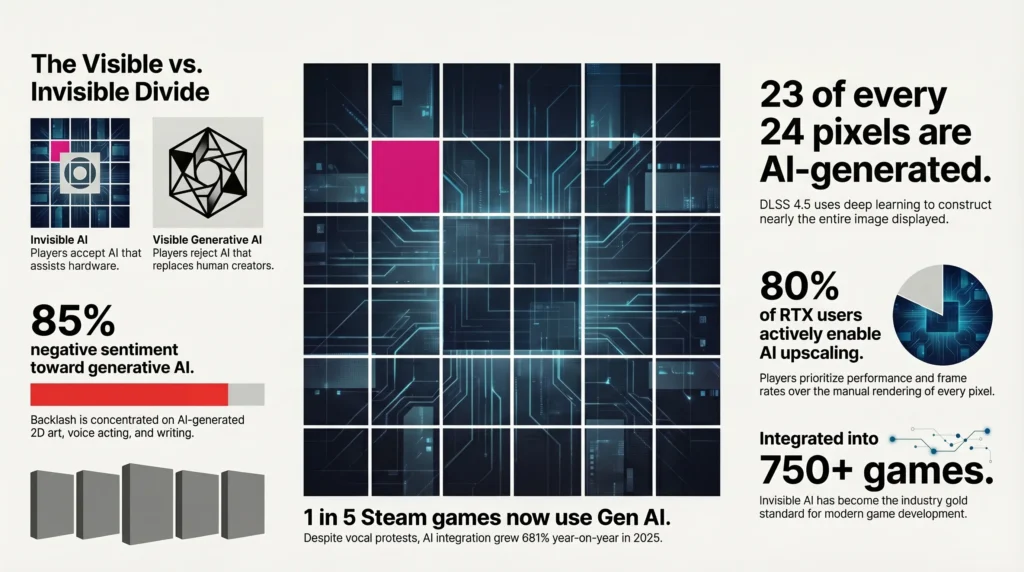
NVIDIA’s DLSS (Deep Learning Super Sampling) is one of the most widely used AI technologies on the planet. According to NVIDIA’s own January 2025 data, over 80% of RTX users activate DLSS when it’s available. The technology has been integrated into over 750 games and is considered an industry gold standard. DLSS 4.5, launched at CES 2025, now uses AI to generate 23 out of every 24 pixels displayed on your screen.
Read that again. Twenty-three out of twenty-four pixels. AI-generated. On a screen belonging to someone who says they hate AI.
This is not a coincidence or a contradiction. It is a pattern. Gamers embrace AI when it does the computational heavy lifting. They push back hard when it does the creative work. The same Quantic Foundry survey that showed 85% negativity toward generative AI also found that using AI for dynamic difficulty adjustment was viewed positively by more than half of respondents. Invisible AI: fine. Visible AI: unacceptable.
We have seen this same pattern play out in game development history. Developers have used AI in games for over 40 years, from the ghost behavior in Pac-Man to the procedural universe of No Man’s Sky. No one complained. Nobody posted a Reddit thread demanding Minecraft remove its AI-powered world generation. Nobody review-bombed No Man’s Sky for generating 18 quintillion planets algorithmically.
The backlash only starts when AI touches the canvas.
Where Exactly Does the Line Get Drawn?
Gamers are more specific than the discourse suggests. They’re not rejecting all AI. They’re rejecting AI in three specific areas: 2D art, voice acting, and writing.
The Quantic Foundry survey broke this down by player motivation. Gamers who prioritize power progression (leveling up, gear upgrades) are actually more favorable toward AI. Gamers who care most about story and design are the most negative. That’s not a coincidence either. The players most invested in the artistic and narrative soul of games are the ones fighting hardest against AI in those exact areas.
This is the invisible vs. visible AI divide in a single data point.
Here’s how the two types of AI stack up in the eyes of the average gamer:
| AI Type | Examples | Gamer Reaction | Reason |
| Invisible AI | DLSS, FSR, NPC behavior trees, procedural generation | Positive or neutral | Improves performance without touching creative output |
| Visible Generative AI | AI art assets, AI voice acting, AI-written dialogue | Strongly negative | Feels like it replaces human creative labor |
| Borderline AI | Dynamic difficulty, adaptive matchmaking, AI-generated quests | Mixed | Depends on whether it feels “earned” or “cheap” |
The pattern is clear. AI that serves the player gets a pass. AI that substitutes for a human creator gets a review bomb.
The Finals: The Perfect Case Study
No single moment captures this tension better than The Finals.
In late 2023, Embark Studios confirmed that their multiplayer shooter used AI-generated voice acting for most of the game’s dialogue and callouts. The backlash was immediate. Professional voice actors took to social media. Prominent figures in the games industry called it out. Players on Steam forums threatened boycotts. The story went viral across every major gaming publication.
Then 7.5 million players showed up to the open beta.
Despite drawing significant criticism, The Finals attracted 260,000 concurrent players on Steam in its first weekend. On December 11 of that year, it ranked as the third most-played game on the entire platform, beating out Baldur’s Gate 3, PUBG, and Skyrim in active users. The game that everyone was boycotting was one of the most-played games in the world.
This is the key data point the AI debate always glosses over. The people loudest on social media and the people actually playing games are not always the same group. The vocal minority shapes the narrative. The silent majority shapes the Steam charts.
This is not unique to AI. We have seen this movie before.
Haven’t We Seen This Pattern Before?
In 2006, Bethesda released horse armor for The Elder Scrolls IV: Oblivion. The price was $2.50. The outrage was enormous. Gamers called it the beginning of the end. Critics said it would destroy the industry. It became a meme that lasted nearly two decades.
Oblivion’s lead designer Bruce Nesmith later reflected: “You’re all making fun of it and yet you buy it.” Today, microtransactions generate billions of dollars annually across the gaming industry. Nobody blinks. The thing that once felt like an unacceptable line in the sand quietly became a Tuesday.
The gaming community is currently in that same phase with AI. The outrage is loud. The behavior tells a different story. According to Tom’s Hardware, 1 in 5 Steam games released in 2025 used generative AI, a 681% increase year-on-year. That growth didn’t happen because players stopped buying those games.
But Wait. Isn’t the Labor Argument Valid?
Yes. And this is the part that the “gamers are hypocrites” argument needs to be honest about.
The distinction between invisible and visible AI is not purely aesthetic. A lot of it comes down to jobs. DLSS does not replace a human worker. It replaces a computational process. AI-generated voice acting replaces a voice actor. AI-generated art replaces a concept artist. That is a fundamentally different moral situation, and gamers who draw that line are making a coherent argument, even if they don’t always articulate it that way.
The GDC 2025 State of the Game Industry report, based on responses from over 3,000 developers, found that 30% of developers believe generative AI is having a negative impact on the industry, up 12% from the prior year. Narrative designers saw the highest layoff rates of any role surveyed, at 19%. The timing is not lost on anyone.
As Yoko Taro warned, the concern isn’t just about aesthetics. It’s about whether the human cost of AI adoption gets acknowledged at all. When studios use AI to cut headcount while posting record revenue, the backlash stops being “performative” and starts being legitimate.
The data supports a nuanced read here. Gamers are not irrationally anti-AI. They are pro-fun, pro-human, and deeply skeptical of studios using AI as a cost-cutting excuse rather than a creative tool. Those are not the same thing.
So What Actually Happens Next?
The data points in one direction: gradual acceptance, with friction.
Here’s why. According to Google Cloud research released at Devcom 2025, 90% of game developers are already using AI in their workflows. The technology is embedded. It is not going away. As generative AI tools get integrated deeper into standard engines like Unreal and Unity, players will increasingly struggle to identify what is AI-made and what isn’t.
That invisibility is the endgame. When gamers can’t see the seams, they stop caring about the machine behind the curtain. They cared about horse armor until they forgot they cared about horse armor. The same trajectory applies here, with one important caveat: the labor question will not quietly disappear the way microtransactions did. That is a structural issue, not a taste issue, and it will require the industry to address it directly rather than hoping players forget.
The studios that get this right will be the ones that use AI to expand what small teams can build, not to eliminate the humans who made those teams worth something.
Frequently Asked Questions
Why do gamers hate AI-generated art but not AI upscaling?
The key difference is what the AI replaces. AI upscaling replaces a computational process and boosts performance. AI-generated art replaces a human artist’s work. Gamers, especially those motivated by story and design, see creative output as having human value that AI cannot replicate.
Did The Finals lose players because of the AI voice acting controversy?
No. Despite significant backlash, The Finals drew 7.5 million players in its open beta and ranked among the top three most-played games on Steam at launch. The controversy generated noise online, but it did not meaningfully reduce player numbers.
Are game developers also against AI?
It’s split. The GDC 2025 survey found that 52% of developers work at companies already using generative AI, while 30% believe it’s having a negative impact on the industry. Attitudes depend heavily on role: business and finance roles are the most enthusiastic, while narrative designers and artists are the most skeptical.
Will AI acceptance in gaming increase over time?
Historical patterns suggest yes. Gaming communities resisted paid DLC, online passes, and microtransactions before normalizing all of them. As AI tools become invisible infrastructure inside game engines, opposition will likely soften, though the underlying labor and quality concerns will need genuine industry responses, not just time.
What AI are gamers already comfortable with in games?
Gamers are broadly comfortable with AI that improves performance (DLSS, FSR), builds game worlds (procedural generation), and adjusts challenge (dynamic difficulty). The negative reaction is concentrated around generative AI in creative roles: art, voices, and writing.

With a profound background in digital strategy and market intelligence, Kishan oversees the overarching editorial direction of IndustrifyAI. He specializes in identifying macro-level AI trends from automotive automation to generative tech and translating them into comprehensive, forward-looking industry forecasts that empower business leaders.